About

Tuesday, January 22, 2019

Orthodox Witnesses to the Immaculate Conception


One of the contested points of doctrine between Eastern Orthodox and Roman Catholic Christians is the issue of the Immaculate Conception of the Holy Mother of God. It is a dogma for Catholics, and highly debatable within Orthodoxy, but in general denied and frowned upon (some will even go as far as to label it a heresy.) This dogma teaches that Mary, the Mother of Jesus, was exempt from a participation in the sin of Adam. (Or a simpler, lay reading: Adam's sin resulted in the loss of communion with God in his soul, and not his soul only, but also that of his descendants, but Mary never suffered from this repercussion.)

It is commonly argued from the side of the Orthodox that the teaching is a deficient development, taking its start from after the schism, and that it leans too heavily on the St. Augustine of Hippo's understanding of Original Sin (and his doctrinal formulations all around are commonly out-of-sync with standard Byzantine understanding. However, it can be sufficiently shown that this teaching is too deeply impressed within the history of the Church to simply be written off as a "papist innovation." Aside from the fact that a strictly Augustinian understanding of Original Sin is not required (for Rome's own stance is not 100% identical to that of St. Augustine) to make sense of the doctrine,  this understanding of Mary as the privileged perfection of mankind, a perfection which takes its origin from the very start of her being, is in fact taught by Patristic theologians, even in the East.

This article does not claim to suggest the Immaculate Conception is the unanimous teaching of the Eastern Fathers, but it does seek to demonstrate that it has its roots in the teachings of the early Church, at least in germ form, and that it is found in the writings of saints revered by both communions, including the East.


SCHOLARLY WITNESSES (Preliminary)

Metropolitan Kallistos Ware:

"The Orthodox Church calls Mary all-holy, immaculate, free from actual sin. The Orthodox Church has never made any formal and definitive pronouncement on the matter of the Immaculate Conception. In the past, individual Orthodox theologians have made statements that, if not definitively affirming the Doctrine of Immaculate Conception, at any rate closely approach it. But since 1854, the great majority of Orthodox reject it as necessary; as implying a false understanding of original sin; as suspecting the doctrine because it seems to separate Mary from the rest of the descendants of Adam and Eve, putting her in a different class. However, if an individual Orthodox today felt impelled to believe it, he could not be termed a heretic for doing so."
(Timothy Ware, The Orthodox Church, 1993 edition, Penguin Press, pages 259-260)
Fr. Laurent Cleenewerck
“There are many Orthodox Christians who make the sweeping statement that this Roman Catholic belief is a heresy ‘flatly rejected’ by the Orthodox Church. When asked to point to a local or Ecumenical Council of the Orthodox Church to justify this assertion, they reluctantly have to admit that there is no such authority—only one’s very private opinion” (His Broken Body, 45)
Fr. Lev Gillet
"It is my own view that not only does the Immaculate Conception not contradict any Orthodox dogma but that it is a necessary and logical development of the whole of Orthodox belief."
______________________________

PATRISTIC WITNESSES


St. Sophronius of Jerusalem


[She is] full of divine wisdom, and free from all contamination of body, soul, and spirit. For this purpose, a holy Virgin is chosen and is sanctified in soul and body; and thus, because pure, chaste and immaculate, she is able to serve in the Incarnation of the Creator.
(Epistola synodica ad Sergium)


St. John Damascene

Nature has been defeated by grace and stands trembling, no longer ready to take the lead. Therefore when the God-bearing Virgin was about to be born from Anna, nature did not dare to anticipate the offshoot of grace; instead it remained without fruit until grace sprouted its fruit. For it was necessary for her to be the first-born, she who would bear the “Firstborn of all creation” in whom “all things subsist” (Col 1.15,17). O blessed couple, Joachim and Anna, all nature is indebted to you! For through you it has offered a gift to the Creator which is more excellent than all [other] gifts: a holy mother who alone is worthy of the Creator. O blessed loins of Joachim, whence the all-pure seed was poured out! O glorious womb of Anna, in which the most holy fetus grew and was formed, silently increasing! O womb in which was conceived the living heaven, wider than the wideness of the heavens” (St. John of Damascus, Homily on the Nativity 2)

St. Andrew of Crete

“Today that [human] nature, which was first brought forth from the earth, receives divinity for the first time; the dust, having been raised up, hastens with festive tread toward the highest peak of glory. Today, from us [Anne’s humanity] and for us [humanity], Adam offers Mary to God as first-fruits, and, with the unpoisoned parts of the muddy dough, is formed a bread for the rebuilding of the human …Today, pure human nature receives from God the gift of the original creation and reverts to its original purity. By giving our inherited splendor, which had been hidden by the deformity of vice, to the Mother of Him who is beautiful, human nature receives a magnificent and most divine renovation, which becomes a complete restoration. The restoration, in turn, becomes deification, and this becomes a new formation, like its pristine state“
(St. Andrew of Crete, Homily 1 on the Nativity of the Blessed Virgin Mary)

Isidore Glabas (d. 1396), Metropolitan of Thessalonika

“The all-pure Virgin, as is right, alone can refuse to apply to herself the words of the royal prophet, she alone can say: I was not conceived in iniquity, and again: My mother did not conceive me in sin; this privilege is contained in the great things done to me by him who is mighty.”

St. Nicholas Cabasilas
“If there are some of the holy doctors who say that the Virgin is ‘prepurified (προκεκαθάρθαι)’ by the Spirit, then it is yet necessary to think that ‘purification’ (i.e. an addition of graces) is intended by these authors, and these [doctors] say that this is the way the angels are ‘purified,’ with respect to whom there is nothing knavish.”

St. George Scholarios
“(She was) all pure from the first moment of her existence”
Cyril Lukaris 
"[The Theotokos] was wholly sanctified from the very first moment of her conception when her body was formed and when her soul was united to her body... As for the Panaghia, who is there who does not know that she is pure and immaculate, that she was a spotless instrument, sanctified in her conception and her birth, as befits one who is to contain the One whom nothing can contain?"

Tuesday, December 11, 2018

Athanasius and the Death of Death

by Nathaniel Richards (from The Rowdy Hobbit)


Athanasius and the Death of Death; Or, Death, Thou Shalt Die

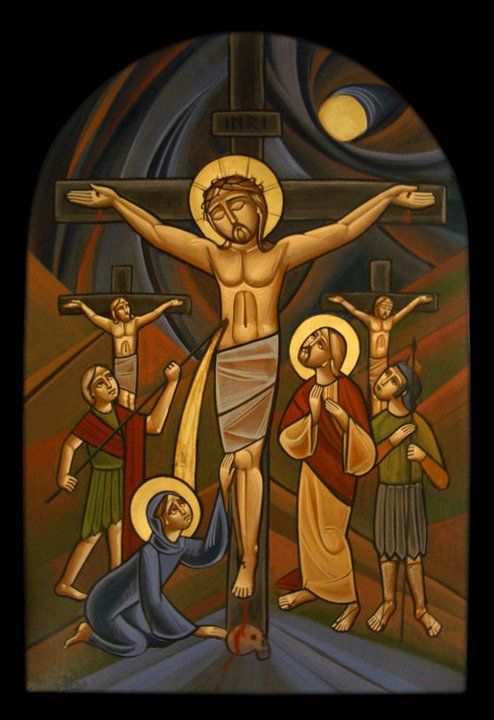
Generally, in the liturgical season of Advent, Christians try to remember the “good part” of salvation history. We’re preparing for our hearts for little baby Jesus to arrive at Christmas. Perhaps we will light the candles on the Advent wreath or set up a manger scene. We read St. Luke’s account of the Annunciation to Mary that she would conceive of the Holy Spirit. We know we’re supposed to only be singing Advent carols, but you know, some Christmas carols sneak in there. O Come, O Come Emmanuel is replaced with Silent Night. Nativity plays take place, holiday candy abounds. Sadly, however, in the excitement of it all, we neglect Christ’s purpose of coming. It’s not just that “He’s the Reason for the Season!” but something more sobering. Our Blessed Lord was born to die.

Archbishop Fulton Sheen, in defense of this point, said simply:
…to Christ, death was the goal and fulfillment of his life, the gold that He was seeking. Few of His words or actions are intelligible without reference to His Cross. He presented Himself as a Savior rather than merely as a Teacher. It meant nothing to teach men to be good unless He gave them the power to be good, after rescuing from the frustration of guilt. (Life of Christ, 14)
Think of this. Nothing in Our Lord’s life, not even the majestic Gloria in Excelsis Deo of the heavenly host to shepherds watching their flocks means anything without Jesus’ death. Yet such a notion upsets us, doesn’t it? Today there’s no greater Scrooge or buzzkill to the secular Christmas season than that of the cross of Our Lord. Furthermore, nothing is as startling to the modern eye as a crucifix. It’s audacious. An actual body is hanging on it. And if there’s one thing we can’t have in modern society, it’s a reminder that all of us will die. A memento mori, as it were, is taboo. It seems to be bad taste. Why would one, in good conscience, try and remember a public execution? We worship a God not of the dead, but of the living, after all (Mark 12:27). Let’s put Jesus back into the manger. As Christians we shirk from the story of the Passion and want to forget the “bad part” because, let’s face it: crucifixion is ugly. We’re afraid of death. Especially when that crucified God is staring us in the face.

According to St. Athanasius of Alexandria, however, a God with a face is precisely the point of the Catholic religion. Recently I spent a night reading his On the Incarnation as a devotional guide to Advent. While that five-times-exiled veteran of orthodoxy had much to say on the wonder that is the Second Person of the Trinity’s assuming human flesh into the Godhead, there was something that struck me. His language was predominantly crucified. Almost eerily obsessed with the way in which Jesus died. In an instructing but loving way, Athanasius says:
…if any honest Christian wants to know why He suffered death on a cross and not in some other way, we answer thus: in no other way was it expedient for us, indeed the Lord offered for our sakes the one death that was supremely good. (On the Incarnation, 54).
God the Son’s death on the cross was supremely good? That’s jarring. How can we say that being stripped naked, whipped to bloody pulp, and being deserted by nearly all your followers is good? Yet Athanasius continues:
He had come to bear the curse that lay on us; and how could He “become a curse” otherwise than by accepting the accursed death? And that death is the cross, for it is written, “Cursed is every one that hangeth on a tree.” Again, the death of the Lord is the ransom of all, and by it “the middle wall of partition” is broken down and the call of the Gentiles comes about. (On the Incarnation, 54-55)
According to St. Athanasius, who was only merely echoing St. Paul in Galatians (who in turn was quoting Deuteronomy), Christ became a curse. That is, as the God-man, Jesus extinguished the sin-tainted nature of the Old Adam and put it to death in Himself, the New Adam. This does not mean the Lord was Himself sinful, the letter of Hebrews clearly teaches He never sinned (Hebrews 4:15).  Rather, it means this: in uniting Himself to humanity in a body, Christ can be both a priest and victim when he undergoes the passion. The cross may be a scandal, but it is the most necessary of scandals. Because Jesus is Emmanuel, God with us, he can know humanity for it really is, and call us back to the heights for which He created us for. Heights which he cleared the way for in the lifting up of His cross. Heights that will lead back to the Father who sent Him. As Athanasius puts it:
How could He have called us if He had not been crucified? Here again, we see the fitness of His death and of those outstretched arms: it was that He might draw His ancient people with the one and the Gentiles with the other, and join both together in Himself. Even so, He foretold the manner of His redeeming death, “I, if I be lifted up, will draw all men unto myself.” (On the Incarnation, 55)
Going along though these mediations Athanasius becomes a little punch drunk. Like St. Paul, he starts boasting. Which is acceptable if it is in the cross (Galatians 6:14). He reveals that, though Christians love the cross of Our Lord, we don’t really love death in and of itself. Instead, he notes:
All the disciples of Christ despise death; they take the offensive against it and, instead of fearing it, by the sign of the cross and by faith in Christ trample on it as something dead. Before the divine sojourn of the Saviour, even the holiest men were afraid of death… .But now that the Savior has raised His body, death is no longer terrible, but all those who believe in Christ tread it underfoot as nothing, and prefer to die rather than deny their faith in Christ, knowing full well that when they die they do not perish, but live indeed, and become incorruptible through the resurrection….Death has become like a tyrant who has been conquered by the legitimate monarch; bound hand and foot as he now is, the passers-by jeer at him, hitting him and abusing him, no longer afraid of his cruelty and rage, because of the king that has conquered him. So has death been conquered and branded for what it is by the Saviour on the cross. (On the Incarnation, 57-58)

As Christians living the Paschal Mystery of Our Lord, death no longer binds the race of Adam like it had. In the Life, Death, and Resurrection of Jesus, there is a new race of men. These men will be crucified, dead, and resurrected. They will rise again to die now no more. And in so doing, both Paul and Athanasius tell us that we will exult in that cry of I Corinthians 15:55: “O Death, where is thy victory? O Grave, where is thy sting?” Our joy rests in that “death is daily proved to be stripped of all its strength” (On the Incarnation, 62). For the Word, having been made flesh, crucified and risen for sinful man, cannot be defeated.


Why is the Incarnate Word undefeatable? The answer is twofold. The first way to approach the question is to realize that Our Lord humbled Himself. The humiliation of the Passion to many eyes seemed a resounding defeat. God the Father knew that His Son was the one sacrifice that would forever fragrance Heaven in the way bullocks never could. Namely, Jesus was the “broken spirit” and the “heart that is humbled and contrite” which the Father could never “disdain” (Psalm 51:19). The second way is this. The humility and great Love of God surpasses the power of death, which can only be proud. Sin entered the world through the pride of man in the Garden and his disobedience. Disobedience was truly made sin because Adam and Eve’s hid from the Lord after the fact. And even then, the Lord walked about the Garden seeking for man created in the imago Dei. As Genesis 3:15—commonly called the Protoevangelium (first Gospel)—shows us, God had a plan to use the woman’s seed to crush the head of that evil serpent. Sin, pain, and death may have entered the world with Original Sin, but God is to be praised. Because with that felix culpa He had a remedy—He would do something to save us. With God’s intervention, Adam would walk once more in Paradise with his Maker.

In the cross and in nothing else, there is freedom. G.K. Chesterton once quipped that “The cross opens its arms to the four winds; it is a signpost for weary travelers” (Orthodoxy, 48). Christ is the leader of our race’s victory over death, why ought we who are purchased with His Precious Blood be ashamed of it? We may get discouraged in our journey during this life, but it is no real reason to despair. Our Lord has put death to death. Christ conquers, reigns, and commands. This Advent season, let us keep in mind the words of Sacred Scripture and those mediations of St. Athanasius. With every glance at the manger, let us also see the wood of the cross, and especially the corpus on the crucifix. Let us put our trust in Him. Let us look upon Him who they have pierced (Zechariah 12:10). For He is lifted in that moment of supposed defeat. Death has been condemned. Eternal life is found in that font which flows from Calvary. And in that lifting of His, even now in our time, hearts are converted; all men are drawn unto that babe born in Bethlehem, born to die. Reveling in the crucified and risen God of our salvation, we can recite those wonderful words of the poet Donne: “One short sleep past, we wake eternally / And death shall be no more; Death, thou shalt die.”

Amen. So be it. Death, thou shalt die.


__________________________________________________________

Works Cited

Athanasius, and C. S. Lewis. On the Incarnation: the Treatise De Incarnatione Verbi Dei. St. Vladimir's Seminary Press, 2002.

Chesterton, G. K. Orthodoxy. Moody Publishers, 2009.

Donne, John. “Holy Sonnets: Death, Be Not Proud by John Donne.” Poetry Foundation, Poetry Foundation, www.poetryfoundation.org/poems/44107/holy-sonnets-death-be-not-proud.

Sheen, Fulton J. The Life of Christ. McGraw-Hill, 1958.

New Writer at this Blog

My friend Nathaniel Richards has graciously agreed to write for my blog. He is somewhat of a kindred spirit -- intellectually disposed, passionately Christian, passionately Catholic. He is a convert from Oneness Pentecostalism via Anglicanism. He blogs about faith over at The Rowdy Hobbit. Please give him a follow.

-j

Thursday, November 1, 2018

A Blog on Assyrian Church Theology

Dear readers,

Today, I have stumbled upon a blog called “East Meets East”, which is dedicated to exploring the theological tradition of the Assyrian Church of the East, somewhat in light of Eastern (Chalcedonian) Orthodoxy.

The author, Fr. Ephraim Alkhas, has not blogged in a while (a matter of years) but from what I’ve read, he does very intentional, thoughtful, scholarly, and charitable writing. There is an obvious interest in truth and in examining the heritage of the Church of the East for what it really is.

For those unfamiliar: the Assyrian Church of the East is an apostolic communion which broke ties with the other churches in light of the Council of Ephesus (431.) This Church has historically been referred to as the “Nestorian” Church (for the sake of convention, if not for the sake of slur,) but it seems as though their Christology does not really qualify as such. This Church sent missionaries even further east than Syria, eventually reaching all the way to China, several centuries before the Jesuits made their first historic mission trips to those regions (surprising them to find any sort of Christianity present upon their arrival.)

This Church also suffered the development of two different schismatic groups, both of which ultimately entered into communion with the Pope of Rome, becoming what is known as the Chaldean Catholic Church (which actually now outnumbers the original Assyrian Church from which it split.)

Church history enthusiasts, theologians, and truth-oriented ecumenists will most likely find this blog highly interesting.

http://eastmeetseastblog.blogspot.com

- - -
St. Ephrem the Syrian, ora pro nobis

Friday, October 19, 2018

The Eucharist: Realist Implications in St. Augustine

No reasonable voice would contest that St. Augustine of Hippo did not believe the Sacraments to be efficacious. It is ceded even by Protestant historians that he believed them to communicate saving, sanctifying grace, and the Eucharist is among them. But what is the nature, in his mind, of the Sacrament itself? No doubt, St. Augustine devoted much of his expositions on the Eucharist to its symbolic nature -- but, is that as far as his own belief actually goes? Or does he go further?

Here are provided some quotes I seldom see quoted by either the Catholics or the Protestants in the debate surrounding his Eucharistic theology. They, I believe, demonstrate a view which far transcends the notion of mere symbolism concerning the Lord's Supper, for they speak on not only the efficacy and grace of the Sacrament, but the Sacrament itself. I believe it is not unreasonable to ascribe to St. Augustine an actual belief in the Real Presence.

On the Remission on Sin, and on the Baptism of Infants 34
The Christians of Carthage have an excellent name for the sacraments, when they say that baptism is nothing else than Salvation, and the sacrament of the body of Christ nothing else than Life. Whence, however, was this derived, but from that primitive, as I suppose, and apostolic tradition, by which the Churches of Christ maintain it to be an inherent principle, that without baptism and partaking of the supper of the Lord it is impossible for any man to attain either to the kingdom of God or to salvation and everlasting life? ...We therefore ought not to doubt that even for infants yet to be baptized was that precious blood shed, which previous to its actual effusion was so given, and applied in the sacrament, that it was said, "This is my blood, which shall be shed for many for the remission of sins."


From Ennarations on the Psalms, 33[34]:1
"And was carried in His Own Hands: how carried in His Own Hands? Because when He commended His Own Body and Blood, He took into His Hands that which the faithful know; and in a manner carried Himself, when He said, This is My Body."

From The Confessions 8:23
"For He judges and approves what He finds right, but disapproves what He finds amiss, whether in the celebration of those sacraments by which are initiated those whom Your mercy searches out in many waters; or in that in which the Fish Itself is exhibited, which, being raised from the deep, the devout earth feeds upon…"

From Sermon 228B*

"No longer is a victim sought from the flocks for a blood sacrifice, nor is a sheep or a goat any more led to the divine altars, but now the sacrifice of our time is the body and blood of the priest himself."

"So Christ our Lord, who offered by suffering for us what by being born he had received from us, has become our high priest for ever, and has given us the order of sacrifice which you can see, of his body that is to say, and his blood. When his body, remember, was pierced by the lance, it poured forth the water and the blood by which he cancelled our sins. Be mindful of this grace as you work out your salvation, since it is God who is at work in you, and approach with fear and trembling to partake of this altar. Recognize in the bread what hung on the cross, and in the cup what flowed from his side."

"And therefore receive and eat the body of Christ, yes, you that have become members of Christ in the body of Christ; receive and drink the blood of Christ.

"You were able to read or to hear this in the gospel before, but you were unaware that this eucharist is the Son. But now, your hearts sprinkled with a pure conscience, and your bodies washed with pure water, approach him and be enlightened, and your faces will not blush for shame (Ps 34:5). Because if you receive this worthily, which means belonging to the new covenant by which you hope for an eternal inheritance, and if you keep the new commandment to love one another, then you have life in yourselves. You are then, after all, receiving that flesh about which Life itself says, The bread which I shall give is my flesh for the life of the world; and Unless people eat my flesh and drink my blood, they will not have life in themselves.

Wednesday, October 3, 2018

The Firstborn Son

We know that the whole creation has been groaning together in the pains of childbirth until the present time. 
Romans 8:22
Aside from the texts which refer to the brothers of the Lord, the other frequently cited passage to bolster the argument against the Perpetual Virginity of Mary is Matthew 1:24-25. The Scripture reads:
"Then Joseph being raised from sleep did as the angel of the Lord had bidden him, and took unto him his wife: And knew her not till she had brought forth her firstborn son: and he called his name Jesus."
Matthew 1:24-25 (KJV)
There are two words which, especially in conjunction with one another, appear to damn the idea that Mary bore no other children besides Jesus the Christ. They are the words "firstborn" and "till" -- words which, to those unfamiliar with the nuances of the Sacred Texts, would sequentially necessitate that there must have been other children which followed the birth of Christ. But we shall delve into and shed light on the texts, and reveal these nuances, discovering that no such necessity actually exists. Both terms carry Hebraic functions which speak beyond their simplistic meaning.

"Firstborn"

The Flight into Egypt, Carlo Dolci (1616-1686), oil on canvas
To the ears of moderns, the term "firstborn" would seem to imply that there must necessarily also be, at the very least, a second born. But this is not how ancient Jews and Christians would have understood the term. Rather, when God instructs Moses on the consecration of the firstborn throughout the land, this is how the concept is described:
The Lord said to Moses: Consecrate to me all the firstborn; whatever is the first to open the womb among the Israelites, of human beings and animals, is mine.
Exodus 13:1-2 
This consecration of the firstborn, being one of the commandments of Almighty God given to the people of Israel, would have been equally applicable, presumably including the occasion when a family or an animal had only one offspring. The firstborn is nothing more than that which opens the womb for the first time.

All in all, if Mary had no other children besides the Lord, He nevertheless would still have been "the first to open the womb." (Linguistically, it's no different than the man who settled down with his high school sweetheart and explains it by saying that he married "his first girlfriend.")

"Until/Till/'Til/Unto"

Just as "firstborn" doesn't necessarily imply a "second born", neither does the word "until" necessarily imply any sort of termination of circumstance. On the contrary, sometimes it merely used for emphasis of that circumstance, affirming its details up to a certain point in time, with no bearing on what happens afterwards.

This is not an argument for some unique and abstract usage of the word "until"; the examples found in Scripture are copious indeed. Here are but a few examples:
  • "And he [Noe] sent forth a raven; and it went forth and returned not until the water was dried from off the earth." Genesis 8:7 LXX

    [Yet anyone who's familiar with this story knows that the raven, famously, never returned to Noah.]
  • "And he buried him [Moses] in a valley in the land of Moab, over against Bethpeor: but no man knoweth of his sepulchre unto this day." Deuteronomy 34:6 (KJV)

    [The day after these words were written down, was the body of Moses then discovered?]
  • "As to Michal daughter of Saul, she had no child till the day of her death." 2 Samuel 6:23 (YLT)

    [Should we conclude that on the day she died, Michal gave King David a child?]
  • "David also said to Solomon his son, 'Be strong and courageous, and do the work. Do not be afraid or discouraged, for the Lord God, my God, is with you. He will not fail you or forsake you until all the work for the service of the temple of the Lord is finished'" 1 Chronicles 28:20 (NIV)

    [Is God only unfailing and faithful while there is work left for his servants to be done?]
  • "From the rising of the sun till to the going down (From the rising of the sun until the going down of the same); the name of the Lord is worthy to be praised." Psalms 113:3

    [Is God's name not worthy of praise in between sunrise and sundown?]
  • "And even to your old age I am he" Isaiah 46:4 (KJV)

    [After man is old and fades away into death, is God no longer God?]
  • "And behold, I am with you all the days, until the completion of the age." Matthew 28:20b (BLB)

    [Does this mean that when the age is completed, Christ will no longer be with his disciples?]
  • "We know that the whole creation has been groaning together in the pains of childbirth until the present time." Romans 8:22

    [If you read the wider context, Paul is very assertive that earth still has yet to give birth.]
  • "And they went up to mount Sion with joy and gladness, and offered holocausts, because not one of them was slain, till they had returned in peace. "1 Maccabees 5:54 (DRA)

    [Does "till" imply that once Judah Maccabeus and men returned safely, at least one of them were slain?]
In these passages, this linguistic function of the word is utilized so as to emphasize the point of the text. The meanings of these other texts, are of course rather, obvious. By saying Michal bore no children "til" the day of her death, it communicates that throughout her whole life, she never bore children. Likewise, the Messiah's statement "I am with you always, until the completion of the age", communicates His unwavering fidelity, which actually reaches beyond the scope of time.

So then, what point is being emphasized in Matthew 1:25 by the inclusion of these words? That at no time at all during Mary's pregnancy of Christ did Joseph ever compromise her virginal integrity. (The dynamic force of its inclusion might interpret the verse along the lines of "he knew her not even until she brought forth her firstborn.") It operates so as to stress, to affirm against suspicion surrounding the matter, that the Lord Jesus Christ was truly conceived and born of a virgin. The purpose of this verse isn't to inform the reader about what would later become of the Lord's family, but is rather about the Lord himself, emphasizing and insisting that his miraculous birth was truly and only that: miraculous.


"I also shall make him My firstborn, The highest of the kings of the earth."
Psalms 89:27

Thursday, September 27, 2018

Liturgical Theology of Latin Rite Matrimony (Peter Totleben, O.P.)


Over at Gabriel Sanchez's blog Opus Publicum, he put up an excerpt and some commentary from Orthodox Scholar Fr. John Meyendorff on the subject of the Sacrament of Marriage. It carries the usual Eastern critique of Western marriage theology. These are Meyendorff's words:
Many confusions and misunderstandings concerning marriage in our contemporary Orthodox practice would be easily eliminated if the original connection between marriage and the Eucharist were restored. Theoretically, Orthodox sacramental theology, even in its scholastic, textbook form, has preserved this connection in affirming, in opposition to Roman Catholicism, that the priest is the ‘minister’ of marriage. Western medieval theology, on the contrary, has created a series of confusions by adopting, as in so many other points Roman legalism as the basis of sacramental theology: marriage, being a ‘contract’, is concluded by the husband and wife themselves, who are therefore the ‘ministers’ of the sacrament, the priest being only a witness. As a legal contract, marriage is dissolved by the death of one of the partners, but it is indissoluble as long as both are alive. Actually, indissolubility i.e., a legal concept taken as an absolute is the main, if not the only, contribution of Christianity to the Roman Catholic concept of marriage. Broken by death, assimilated with a human agreement, marriage, in the prevailing Western view, is only an earthly affair, concerned with the body, unworthy of entering the Kingdom of God. One can even wonder whether marriage, so understood, can still be called a sacrament. But, by affirming that the priest is the minister of the marriage, as he is also the minister of the Eucharist, the Orthodox Church implicitly integrates marriage in the eternal Mystery, where the boundaries between heaven and earth are broken and where human decision and action acquire an eternal dimension.

Orthodox Christians commonly accuse the West of a legalistic understanding of marriage, claiming it is purely consent based and has no real ecclesial function in its essence, and that it does s not carry any eschatological significance.

However, an erudite reply from Dominican Br. (now Fr.) Peter Totleben put up a response that really delves into the history and sacramental theology of marriage for the Western Church, one which explains the sacerdotal relevance to the sacrament, and a fantastic brief but dense exegesis of the famous passage from Matthew where Christ answers the Saducee's question on marriage and the resurrection.

It highly impressed me, enough to the point where I thought it warranted its own blog post. So I offer you the same erudition he offered me and all of Gabe's readers. I hope it benefits the overall dialogue on this issue.

"A typical pattern that you see in the works of Meyendorff (especially when he is critical of Western practices) is that he takes a term, a tag, or a catch-phrase that strikes him as odd, gives it his own meaning, and then criticizes it in terms of the meaning he has given it. So he can be a bit hard to engage. 
There are also some problems with Meyendorff’s historical work. He’s usually invested in a particular “side” in the historical events that he investigates. And he doesn’t really take the positions of other sides seriously. He usually is too trusting of his own party’s evaluations of its opponents, and he uncritically repeats them as if they were objective summaries of the state of affairs. And he never really consults what the opponents of his side have to say. 
So, reading Meyendorff can sometimes be like letting Rush Limbaugh explain democrats to you. . . 
That’s pretty much what is happening in this quote. Meyendorff treats “contract” and “indissolubility” as if his understanding of these two terms exhausts the understanding of marriage of the Latin Church. Then he concludes that there is nothing particularly Christian about any of it. But of course, a more integral reading of the Latin tradition (or even a slightly less superficial treatment of it) would show that this is nonsense on stilts.
Really, what’s going on here is that the Latin Church makes a clearer distinction between natural and sacramental marriage. Natural marriage is elevated to the dignity of a sacrament. It’s just an observation of the evident fact that non-Christians fall in love, get married and have children. It’s “the one blessing not lost by the fall.” And it is good. You don’t need grace to make nature good. 
And, in fact, every sacrament presupposes some good natural action. Baptism presupposes washing with water; confirmation presupposes anointing with oil; the Eucharist presupposes offering a sacrifice and eating; penance presupposes the actions of confession, contrition, and satisfaction on the part of the penitent. Likewise, marriage as a sacrament presupposes the committed procreative love of the spouses–i.e. natural marriage. It is this which gets elevated and changed into a sign and instrument of grace. (And the sign has a composite signification with reference to the past, present and future, so the marriage has an inherently eschatological dimension). 
If marriage is an institution of nature, then it is reasonable to suppose that it began with the consent of the two spouses. This is the basis behind the Latin view that consent makes the marriage. But this is without prejudice to either the intercession of the Church or God’s causality. 
In the Latin Church, the priest is not simply a witness to the contractual exchange of consent, and this is evident from the liturgy of Marriage. In the traditional rite, the priest even says, “I join you in matrimony, in the name of the Father and of the Son, and of the Holy Spirit.” Then, the ritual instructs him, “If the nuptial blessing is to take place [ie. if both parties are Catholic], the Pastor celebrates the Mass pro Sponso et Sponsa.” This is because the nuptial blessing (uniquely) is given between the anaphora and communion (where the bride and groom share in the Eucharist). What is really puzzling is that Meyendorff is criticizing Catholics for separating the meaning of marriage from the meaning Eucharist, while the Orthodox have maintained it, when it is the Catholics who have so carefully maintained the connection between the celebration of marriage and the celebration of the Eucharist. It is a bit odd to explain to an Orthodox theologian that the liturgy is supposed to be an important source for theology, but there you go. 
(Actually, this whole dispute over who is the minister of marriage is overblown. In the Byzantine period, the Orthodox Church was responsible for the administration of civil marriage, and they witnessed the consent of the couple as a matter of course, and then blessed them. The Catholic Church would at times admit the validity, but not the liceity of clandestine marriage. However, marriage before a priest was the norm. And for centuries now, the liturgical rite of marriage has been required even for a valid marriage)
Nor does the doctrine that consent makes the marriage neglect God’s causality. 
Meyendorff highlights how the couples are the ministers of the sacrament of marriage. What Meyendorff doesn’t tell you is that the minister of the sacrament is always an instrumental cause. In the administration of the sacraments; there is a synergy between God and the human minister, with the human minister subordinated to God’s causal action. No one ever supposed that two baptized people simply ratify a contract, and that is all that marriage is. It is also a bit odd that one has to remind an Orthodox theologian about the doctrine of God’s synergy with human actions, but again, there you go.) 
Seen from this light, the Latin Church is not assimilating marriage to a human contract, but is saying that God enters into a synergy with the couple, deifying their human love to make it a sign and instrument of — or, if you like, an eschatological participation in — his heavenly kingdom. It is simply absurd to assert that the Latin church makes of marriage “only an earthly reality.” 
But that doesn’t mean that marriage carries over into heaven. On a natural level, marriage is for the procreation and upbringing of children. This type of family organization will not obtain in heaven. On a sacramental level, marriage is an eschatological sign and instrument of God’s covenant love for his people, as this is shown in Christ’s love for his Church. Sacraments are for this world. Precisely by calling them sacraments (or mysteries in St. Paul’s sense) and by giving them an eschatological dimension, you are conceding that they are for this world. (You don’t need a sacrament of the kingdom once the reality of the kingdom is consummated.) 
Think about the Eucharist. We will not celebrate the Eucharist in heaven, because we will not need a sacramental liturgy in heaven. In heaven, sacramental worship gives way to a worship of a more un-mediated sort. Priests remain priests in heaven, of course (they are still marked by their character), but they do not exercise their sacramental functions. The hierarchy of sacramental ministers gives way to the hierarchy of charity which is the flourishing of the baptismal priesthood. (Monks remain monks because consecrated life is a more intense participation). Marriage, however, is a type of relationship that is radically characterized by its procreative dimension–that’s why marriage itself, even in its sacramental form passes away at death. 
This is really crass, supine, or affected ignorance on the part of Meyendorff. Instead of paying attention to the discipline, liturgy, theology, or magisterial teaching of the Latin Church, he gives a misleading account of its doctrine so that he can engage in an act of petty point-scoring. How does that help anyone?

But I wonder if all of this doesn’t highlight another problem. A lot of the Orthodox thinking on marriage in the 20th century makes it seem like the procreative dimension of marriage is somehow not constitutive of marriage, especially when this is seen as a sacrament. The fundamentally procreative nature of marriage is at the heart of Latin thinking about the sacrament. This is true whether it is a discussion of the “ends of marriage” the “goods of marriage” or the “unitive and procreative dimensions of marriage.” The Catholic Church has been pretty consistent in arguing that these cannot be separated. 
The Church’s position is often misunderstood. People often think of the unitive and procreative ends of marriage as two really distinct things, and then wonder which is primary. (It’s like the old SNL commercial parody: “It’s a floor wax and a dessert topping.”) But that’s not really the right way to think about it. What a thing is is specified by its end, and so a thing can’t have two ends. Actually the procreative and unitive “ends” of marriage aren’t really distinct. Marriage isn’t a friends-with-exclusive-benefits sort of arrangement. Natural marriage has only one end: a procreative end. It’s not just any sort of union, and the sexual act is not accidental to the sort of union that it is. A husband and a wife literally fit their bodies together so that they become one agent, one cause in the creation of a new life. 
And it is important to get fleshy like that when talking about marriage, because that is what makes marriage different from any other kind of union or friendship. When you read modern Orthodox writing about the sacrament of marriage, it seems to sacramentalize the unitive aspects of marriage, while factoring out the procreative nature of that union. But the reason why marriage is a sacrament and other kinds of friendship aren’t is precisely because of the special kind of friendship (i.e. a procreative one) that marriage is. 
And, of course, if marriage is fundamentally about turning procreative union into a sacrament of the kingdom, then marriage does not continue into heaven. In Matthew 22, Jesus did not say that the woman would not have sex with any of her seven husbands in heaven. He said that none of the seven would be her husband–even though she had sex with all of them on earth. 
Nor is it an argument against this position that we will continue to love our families in heaven. Of course we will. But from this it does not follow that we are still married.
Like so much of what is found in 20th Century Orthodox writers, I’m not sure how well-grounded it actually is in the texts of the Greek Fathers. At any rate, when reading the Fathers, we need to recall that they were living in a culture that took the procreative nature of marriage for granted, and a culture that had a strong pagan background where the unitive implications of marriage needed to be emphasized. 
Actually, I think that a lot of modern Orthodox writers are explicitly trying to appeal to the post-Cartesian sensibilities of their readers. And, as is unfortunately so often the case with 20th century Orthodox writers, “ancient faith” and “light from the East” really just means thinly-veiled modernism. 
It is actually this modern, “de-fleshified” concept of marriage that is behind many of the deviations from traditional Christian morality that some Orthodox writers are trying to promote. Once marriage is no longer fundamentally procreative, there is no reason why you can’t use contraception. Once marriage is no longer essentially characterized by the meaning of the sexual act (the way that the husband and wife become the one cause of their child and are responsible for raising it), there’s no reason the husband and wife can’t move on. 
It’s not that Catholics make marriage only an earthly affair, it’s that Orthodox make it only a heavenly one."