About

Tuesday, April 30, 2019

Age of Accountability in the Book of Deuteronomy

For those who say that the Catholic concept of the "age of accountability" isn't a Biblical concept,..

Israel was given chance after chance to stay faithful to God, but the first generation of Israelites which Moses led out of Egypt were finally told by God that, because of their disobedience, they would not enter into the promised land.

However, there were certain exceptions which were mentioned:
Not one of these men of this evil generation shall see the good land which I swore to give to your fathers, except Caleb the son of Jephun′neh; he shall see it, and to him and to his children I will give the land upon which he has trodden, because he has wholly followed the Lord!’ The Lord was angry with me also on your account, and said, ‘You also shall not go in there; Joshua the son of Nun, who stands before you, he shall enter; encourage him, for he shall cause Israel to inherit it. Moreover your little ones, who you said would become a prey, and your children, who this day have no knowledge of good or evil, shall go in there, and to them I will give it, and they shall possess it. But as for you, turn, and journey into the wilderness in the direction of the Red Sea.’
(Deuteronomy 1:35-40, emphasis on verse 29 mine)
The Bible itself says that children can be too young to understand good and evil, and this passage illustrates that they do not share in the condemnation which fall upon evil doers.

Saturday, April 27, 2019

A Closer Look: St. Gregory the Great's Contention with “Universal Bishop”

It was towards the tail end of the sixth century. John IX, or John the Faster, Patriarch of Constantinople, given that he was Patriarch of the Byzantine empire's capital, attributed to himself the title of "Universal Patriarch," "Universal Bishop" and "Universal Priest." His contemporary, Gregory I, Pope of Rome, did not react with much joy at the situation... but not for the reasons which those unfamiliar with Church history might assume. For those unfamiliar with this episode of history, especially if they are faithful Catholics, his reaction may come across as deeply confusing and even shocking.
[W]hat will you say to Christ, who is the Head of the universal Church, in the scrutiny of the last judgment, having attempted to put all his members under yourself by the appellation of Universal? Who, I ask, is proposed for imitation in this wrongful title but he who, despising the legions of angels constituted socially with himself, attempted to start up to an eminence of singularity, that he might seem to be under none and to be alone above all?
(Letter 5:18)
Now I confidently say that whosoever calls himself, or desires to be called, Universal Priest, is in his elation the precursor of Antichrist, because he proudly puts himself above all others.
(Letter 7:33 emphasis mine)
,
These are some strong words. Pope Gregory imputes to the one who would appropriate the title "universal" for themselves a fatal pride, one which even precursors the Antichrist. What does the Catholic, who believes in, according to the definition of the First Vatican Council “the universal and immediate jurisdiction of the Roman Pontiff over the whole church,” make of them? Do they undermine the veracity of Catholic dogma? Do they, coming from one of the papacy’s most famous occupants, constitute a historical witness against its current claims to power?

Protestants and Orthodox have often seized upon these words from Pope St. Gregory and answered an affirmative “yes” to this question. In their mind, it presents a swift "checkmate" against the claims of Roman Catholicism. Yet I would argue that to simply take them at face value, without historical context, quite obscures the picture. There are some very intriguing nuances which should be held in mind when assessing the situation.

In response to their criticism, it is commonly argued by papal apologists (and I am increasingly inclined to think correctly) that he perceived the phrase of “universal bishop” as more or less equating to an unique, only, singular, exclusive, all-encompassing bishop. Calling someone a “universal bishop” would be, in Gregory’s mind, be the same as calling them the only bishop, with the whole universal Church on earth as their diocese. This would reduce the other bishops to simply being the pope’s subsidiaries, his vicars, his agents, and not true bishops at all. Their authority to govern would be purely and unqualifiedly derivative.
For, having confessed yourself unworthy to be called a bishop, you have at length been brought to such a pass as, despising your brethren, to covet to be named the only bishop.
(Letter 5:18, to John IX, emphasis mine)
[T]his thing is being done to the injury and rendering asunder of the whole Church, and, as we have said, to the contemning of all of you. For if one, as he [John the Faster] supposes, is universal bishop, it remains that you are not bishops.
(Letter 6:98, to bishop Eusebius of Thessaloniki, emphasis mine)
Contrary to this understanding is the doctrine held by the Roman Church. The very council which formally promulgated the papacy as a dogma of the Catholic faith, Vatican I, itself affirmed that the office of bishop is a divine institution, that is, an office immediately appointed by God by having Christ as its founder, with its own integrity and carrying its own dignity. The council fathers cited the The Book of Acts (of the Apostles) , in which St. Paul says said “the Holy Ghost hath made thee overseers (bishops).” (Acts 20:20).

Further, it should be noted that the papal office should not be understood as above the episcopate, but as within the episcopate, as part of it, and as the episcopate's own principle of unity and integrity. As St. Cyprian of Carthage and other fathers would convey, the episcopal charism is a Petrine charism; Peter was the first to be made bishop, to be given the authority to bind and loose, and the apostles would later also be made to share in what Peter was given. In a like manner, the Pope is entrusted with the care of all Christians, and all the bishops proportionately share in this same responsibility. The papacy shares an identity as Church, as Teacher, as Vicar of Christ, with the episcopate, so that the Pope functions as the episcopate’s figurehead, its governmental and moral summation, its unifying force and its charismatic foundation.

So, the connotations of the term “universal bishop” held by Pope Gregory and by later popes would thus in fact appear to differ from one another; they present to us two different concepts. One usage communicates the responsibility due to the whole Church which is uniquely held by the Bishop of Rome; the other as a restrictive and singular government to the exclusion of those others with a valid, innate right to perform their proper duties. Therefore, seeing that they meant two different things when using it, it presents no contradiction to see Pope Gregory I denounce the title and later popes apply it. 

However, let’s set aside this interpretation of the event, and cede for the sake of argument that the title did in fact mean “universal” as the Popes would later intend. Seeing a Pope of Rome describe the operations as diabolical and a prelude to Antichrist constitute a devastating blow to the claims of the papacy — or does it?

The pontificate of Gregory I is a very historically noteworthy one — he is not known as Gregory “the Great” for nothing, after all. It is a marked by a concerted display of power and influence. The Encyclopedia Britannica [link: here] notes him as "'founder' of the medieval papacy, which exercised both secular and spiritual power" and as "the first exponent of a truly medieval, sacramental spirituality." 

He not only denied the title when it was applied to John the Faster, patriarch of Constantinople, but also rejected the title when others applied to himself.
"... you have thought fit to make use of a proud appellation, calling me Universal Pope. But I beg your most sweet Holiness to do this no more..."
(Letter 8:30)
In this letter, the Patriarch of Alexandria, Eulogios, referred to him as “Universal Pope.” This is truly significant because as Patriarch of Alexandra, Eulogius was, via St. Mark's commission from Peter to found and rule over the Church of Alexandria, also a successor of St. Peter. (The Pope had even acknowledged this in the letter which solicited Eulogius' initial compliments of him being "Universal Pope!") This demonstrates other bishops, even Eastern bishops such as Eulogios, evidently saw the papal office as functioning at a universal level. He even returned the Pope's letter with a spirit of subordination, replying that he had done “as you [Pope Gregory] had commended.”

Further, Gregory himself admitted that the title “univeral” was offered to Rome at the council of Chalcedon over one hundred years prior, demonstrating an antiquity of the attestation to this recognition by Eastern bishops. In his written chastisements of John IV of C'nple,

Was it not the case, as your Fraternity knows, that the prelates of this Apostolic See which by the providence of God I serve, had the honor offered them of being called universal by the venerable Council of Chalcedon. But yet not one of them has ever wished to be called by such a title, or seized upon this ill-advised name, lest if, in virtue of the rank of the pontificate, he took to himself the glory of singularity, he might seem to have denied it to all his brethren
(Letter 5:18)
Certainly, in honour of Peter, Prince of the apostles, it was offered by the venerable synod of Chalcedon to the Roman pontiff. But none of them has ever consented to use this name of singularity, lest, by something being given peculiarly to one, priests in general should be deprived of the honour due to them. How is it then that we do not seek the glory of this title even when offered, and another presumes to seize it for himself though not offered?
(Letter 5:20)
And Pope St. Gregory, though not appropriating the term "universal" to himself, certainly did ascribe to himself and to his see an incontestable headship over the whole Church.
For as to what they say about the Church of Constantinople, who can doubt that it is subject to the Apostolic See (i.e. Rome), as both the most pious lord the emperor and our brother the bishop of that city continually acknowledge? Yet, if this or any other Church has anything that is good, I am prepared in what is good to imitate even my inferiors, while prohibiting them from things unlawful. For he is foolish who thinks himself first in such a way as to scorn to learn whatever good things he may see.(Letters 9:12, emphasis mine)
If, however it is stated in opposition to this, that he has neither metropolitan nor patriarch, it must also be said that the case must then be heard and settled by the Apostolic See, which is the head of all the churches.
(Letters 13:50)
Inasmuch as it is manifest that the Apostolic See is, by the ordering of God, set over all Churches, there is, among our manifold cares, special demand for our attention, when our decision is awaited with a view to the consecration of a bishop.  . . . you are to cause him to be consecrated by his own bishops, as ancient usage requires, with the assent of our authority, and the help of the Lord; to the end that through the observance of such custom both the Apostolic See may retain the power belonging to it, and at the same time may not diminish the rights which it has conceded to others.
(Letters 3:30)
To John the Faster, Gregory writes the following:
For, having confessed yourself unworthy to be called a bishop, you have at length been brought to such a pass as, despising your brethren, to covet to be named the only bishop. And indeed with regard to this matter, weighty letters were addressed to your Holiness by my predecessor Pelagius of holy memory; in which he annulled the acts of the synod, which had been assembled among you in the case of our once brother and fellow bishop Gregory, because of that execrable title of pride, and forbade the archdeacon whom he had sent according to custom to the threshold of our lord, to celebrate the solemnities of mass with you. But after his death, when I, unworthy, succeeded to the government of the Church, both through my other representatives and also through our common son the deacon Sabinianus, I have taken care to address your Fraternity, not indeed in writing, but by word of mouth, desiring you to restrain yourself from such presumption. And, in case of your refusing to amend, I forbade his celebrating the solemnities of mass with you; that so I might first appeal to your Holiness through a certain sense of shame, to the end that, if the execrable and profane assumption could not be corrected through shame, strict canonical measures might be then resorted to.
(Letters 5:18, emphasis mine)
And, he connected this primacy with the Apostle Peter, from whom he believed that he, as bishop of Rome, inherited. 
For to all who know the Gospel it is apparent that by the Lord’s voice the care of the whole Church was committed to the holy Apostle and Prince of all the Apostles, Peter... Lo, he received the keys of the heavenly kingdom, and power to bind and loose is given him, the care and principality of the whole Church is committed to him, and yet he is not called the universal apostle... Certainly, in honour of Peter, Prince of the apostles, it was offered by the venerable synod of Chalcedon to the Roman pontiff. But none of them has ever consented to use this name of singularity...
(Letters 5:20)
Finally, and perhaps more significantly, we should address how Gregory has been assessed and understood in our own day.  This very same Pope, who we are supposed to believe denounced any inclination, is reported by historians and theologians, even those Protestant in creed, to be the first modern Pope, the first to exercise his office in a form recognizable to the perceptions of later generations. The same man who could not stomach the patriarch of Constantinople being referred to as “universal bishop” had no scruples in the Pope of Rome (himself) being called “the servant of the servants of God.” He was in fact the first to do so.

In the words of Reformed scholar Phillip Schaff,

Gregory, while he protested in the strongest terms against the assumption by the Eastern patriarchs of the antichristian and blasphemous title of universal bishop, claimed and exercised, as far as he had the opportunity and power, the authority and oversight over the whole church of Christ, even in the East... he was clearly inconsistent in disclaiming the name, and yet claiming the thing itself. The real objection is to the pretension of a universal episcopate, not to the title. If we concede the former, the latter is perfectly legitimate.
(History of the Christian Church, Volume IV: Mediaeval Christianity. A.D. 590-1073, 51. Gregory and the Universal Episcopate)

And Jaroslav Pelikan, Lutheran at the time when he authored this, writes:

The bishop of Rome had the right of his own authority to annul the acts of a synod. In fact, when there was talk of a council to settle controversies, Gregory asserted the principle that ‘without the authority and consent of the Apostolic See, none of the matters transacted have any binding force’. …he was already beginning to formulate a doctrine of the dogmatic authority of Rome, based on the primacy of Peter and corroborated by a record and reputation for doctrinal orthodoxy.
(The Christian Tradition, Vol. 1- page 354)
Finally, reputable Oxford scholar and Church historian J.N.D. Kelly asseses that, as far as Gregory the Great was conscerned, "St. Peter’s commission made all churches, Constantinople included, subject to Rome" (Oxford Dictionary of Popes, p. 67)

So, on the one hand, when it came to the title of “Universal Bishop”, Gregory himself likely didn’t mean what later popes would understand by it, meaning what he rejected and they accepted are two different things. He rejected it on grounds that it should exclude the other bishops; later popes accepted it and did not see it as excluding other bishops. On the other hand, even though he rejected the title, it seems odd that he should have. He himself recognized an authoritative primacy held by himself and the Roman Church, the term "universal" was in fact applied to himself within his own lifetime by another Petrine patrirarch, and his overall papacy operated in a way which (consistent with its usage by later popes) was very consistent with the meaning intended by the title.

In closing, with all due respect not only to our dear Pope St. Gregory, but also to our dear Orthodox and Protestant dissenters who wish to use his words to undermine the papal office , I think, in light of the evidence, but this may not be a checkmate after all.Actions speak louder than words, so perhaps his actions show forth a more informed, truer attitude and understanding in regards to his office as Pope of Rome. The impression he left upon his contemporary brother bishops and patriarchs, and upon later historians of our own day, show us this: whatever be his understanding of and attitude towards the title itself, Pope Gregory’s  administration of the papal office is certainly reflective of the description of “universal bishop,” in the sense which is consistent with the utterances of later popes.

SCRIPTURE: Rejection of Natural Law Leads to Depravity

It is Catholic teaching that God is able to be known through reason alone, without the assistance of Divine Revelation. The doctrine, officially promulgated as dogma by the First Vatican Council, is sometimes misunderstood, but what it means is that man has been given sufficient intellect to perceive through the created world that there is indeed a Creator, without need of recourse to some divine oracle, such as that of Mt. Sinai (not that intellect alone, without grace, can put someone into a relationship with God.)

St. Paul the Apostle expounds on Natural Law in
his epistle to the Romans
Man can know by his own faculties (principled upon that he is made in the Image of God, and that God's very Logos is "the light which enlightens every man" as St. John puts it) that there is indeed a God and that there a true moral standard imposed on mankind, to which mankind must submit. This, in a word, (the word of the Catholic tradition to be precise,) is Natural Law. It is the apparent principle within creation which makes man able of perceiving philosophical and moral truths concerning God and the expectations He has enjoined upon his creatures.

Were there no Natural Law, no law of God which shows "that what the [Mosaic] law requires is written on their hearts" (Romans 2:15), what basis could God have for judging Christian and non Christian alike by the same standards of justice? Were they not manifest in some natural way to the natural man, who lacks the supernatural initiation into God's covenant. Thus, the Natural Law is binding upon all mankind, Jew and non-Jew, Christian and non-Christian.

The result of rejecting the Natural Law, however, is a plunge into intellectual, emotional, and spiritual darkness. Intellectual darkness, in that their sin eclipses their reason and they can no longer perceive these truths knowable to them by the principle of the imago Dei. Emotional darkness, that they become automated by their passions (anger, lust, etc) and are plagued by an assault from them. Spiritual darkness, that they become in bondage to and subjugated to dark spiritual forces of hell, giving themselves over to Satan.

And this is exactly what has happened throughout human history. Through the inheritance of original sin, mankind has regularly rejected the natural law and given himself over to evil. Two passages in particular will suffice to demonstrate this, though others could be cited. One is from the Old Testament, and the other from the New.

Wisdom 13:1-9
For all people who were ignorant of God were foolish by nature;and they were unable from the good things that are seen to know the one who exists,nor did they recognize the artisan while paying heed to his works;but they supposed that either fire or wind or swift air,or the circle of the stars, or turbulent water,or the luminaries of heaven were the gods that rule the world.If through delight in the beauty of these things people assumed them to be gods,let them know how much better than these is their Lord,for the author of beauty created them.And if people[a] were amazed at their power and working,let them perceive from themhow much more powerful is the one who formed them.
For from the greatness and beauty of created things
comes a corresponding perception of their Creator.

Yet these people are little to be blamed,for perhaps they go astraywhile seeking God and desiring to find him.For while they live among his works, they keep searching,and they trust in what they see, because the things that are seen are beautiful.Yet again, not even they are to be excused;for if they had the power to know so muchthat they could investigate the world,how did they fail to find sooner the Lord of these things?

Romans 1:18-25
For the wrath of God is revealed from heaven against all ungodliness and wickedness of men who by their wickedness suppress the truth. For what can be known about God is plain to them, because God has shown it to them. Ever since the creation of the world his invisible nature, namely, his eternal power and deity, has been clearly perceived in the things that have been made. So they are without excuse; for although they knew God they did not honor him as God or give thanks to him, but they became futile in their thinking and their senseless minds were darkened. Claiming to be wise, they became fools, and exchanged the glory of the immortal God for images resembling mortal man or birds or animals or reptiles.
Therefore God gave them up in the lusts of their hearts to impurity, to the dishonoring of their bodies among themselves, because they exchanged the truth about God for a lie and worshiped and served the creature rather than the Creator, who is blessed for ever! Amen.

As can be extracted from these Texts, mankind has been given through creation a window into which they can see some general truths of the Creator. The sin of idolatry arose when mankind forfeited those truths for truths of his own making, which are not truths at all. Man "exchanged the truth about God for a lie."

This darkness obscures man's ability to perceive this basic truths of God, and in this darkness, he becomes a slave to lies, to falsehood, and to evil. This is one of the factors that the Blessed God of Heaven sent Son into the world, to be a "light of the world." The very Logos of God became Incarnate in the Person of Jesus Christ, and He came as "the Way, the Truth, and the Life." (Jn. 14:1) This truth, the truth of God, is the truth that sets us free.

_______

(Side tangent: this biblical principle of Natural Law is actually why the Church has looked favorably upon the works of pagan philosophers. It is not that Greek philosophy is on the same moral and spiritual authority as Sacred Scripture or Divine Revelation, but that it vouches for the Biblical assertion that man can know certain truths pertaining to God without direct Revelation. Men such as Socrates and Aristotle rightly rejected the local Athenian cult and its polytheism, perceiving it as intellectually crude and insufficient to explain the origins of the universe. Through their studies, discipline and contemplation, they recognized the need for but One universal principle: an unmoved Mover, a first cause, etc.)

Saturday, April 13, 2019

The Painless Delivery

I will greatly increase your pangs in childbearing;
    in pain you shall bring forth children

Genesis 3:16
Part of the dogma surrounding the person of Mary connotates that not only before and after, but also during the birth of Christ, the Mother of God retained her virginity.

The common verse to which all Christians turn in affirmation of the virgin birth is Isaiah 7:14. In the famous rendering of the King James Version, it reads:
Therefore the Lord himself shall give you a sign; Behold, a virgin shall conceive, and bear a son, and shall call his name Immanuel.
Theotokos of the Sign;
icon named after the
"sign" of Isaiah 7:14
The prophecy firstly iterates "the virgin shall conceive" -- but it does not stop there -- and immediately continues "and bear a son." Neither her conception, nor her birthing, compromises her virginity. This comes out even more clearly when the text is rendered in a literal translation from the Hebrew, which reads "Lo, the Virgin is conceiving, And is bringing forth a son" (Is. 7:14 YLT) She is virgin as she conceives, she is virgin as she brings forth; in other words, the whole pregnancy is virginal, from start to finish.

This is not the only inference from Sacred Scripture. The Prophet Isaiah further furnishes us with one more indication that the Messiah's birth is painless. In it's final chapter, we find another prophecy which describes the miraculous phenomenon with even more precision -- it is rather direct and straightforward:
Before she was in labor
    she gave birth;
before her pain came upon her

    she delivered a son.
(Isaiah 66:7)
So it is not only the virgin conception, but the virgin birth, which constitutes the fulfillment of prophecy, and this has been a general conviction of the historic church. Testimony to this course of events is found remarkably early in church history. Mary's painless delivery is found in Christian literature. The early Christian work, the Ascension of Isaiah, which historian Richard Carrien (an atheist) dates to the late first-early second century, says thus:
Some said: "The Virgin Mary hath borne a child, before she was married two months." And many said: "She has not borne a child, nor has a midwife gone up (to her), nor have we heard the cries of (labour) pains." And they were all blinded respecting Him and they all knew regarding Him, though they knew not whence He was.
(Ascension of Isaiah 11:13-14, c. 100)
And in the Odes of Solomon, a Christian work from the middle of the second century, says this of the birth of Christ:
So the Virgin became a mother with great mercies.
And she labored and bore the Son but without pain, because it did not occur without purpose.
And she did not require a midwife, because He caused her to give life.
(Odes 19:7-9, c. 150)
The most detailed reference to the event comes from the Protogospel of St. James, from roughly the year 145. It describes the passage of the Lord through her virginal womb in much the same way as the twentieth chapter of St. John's Gospel describes the Risen Lord passing through the locked door.

As far as the actual testimony of saints are concerned, we have the following:

St. Gregory of Nyssa
“Though coming in the form of man, yet not in every thing is He subject to the laws of man’s nature; for while His being born of a woman tells of human nature; virginity becoming capable of childbirth betokens something above man. Of Him then His mother’s burden was light, the birth immaculate, the delivery without pain, the nativity without defilement, neither beginning from wanton desire, nor brought to pass with sorrow. For as she who by her guilt engrafted death into our nature, was condemned to bring forth in trouble, it was meet that she who brought life into the world should accomplish her delivery with joy.” (St Gregory of Nyssa, Homily on the Nativity, AD ca. 388)
St. Ambrose of Milan
“Who is this gate (Ezekiel 44:1-4, see above), if not Mary? Is it not closed because she is a virgin? Mary is the gate through which Christ entered this world, when He was brought forth in the virginal birth and the manner of His birth did not break the seals of virginity…There is a gate of the womb, although it is not always closed; indeed only one was able to remain closed, that through which the One born of the Virgin came forth without the loss of genital intactness” (The Consecration of a Virgin and the Perpetual Virginity of Mary, 8:52; ca. AD 391).
St. Augustine of Hippo
“Christ transcends, indeed, the miracles of all besides, in being born of a virgin, and in possessing alone the power, both in His conception and birth, to preserve inviolate the integrity of His mother: but that was done neither before their eyes nor in them. For the knowledge of the truth of such a miracle was reached by the apostles, not through any onlooking that they had in common with others, but in the course of their separate discipleship.” (Tractate 91:3).
St. John Damascene
How can death claim as its prey this truly blessed one, who listened to God’s word in humility, and was filled with the Spirit, conceiving the Father’s gift through the archangel, bearing without concupiscence or the co-operation of man the Person of the Divine Word, who fills all things, bringing Him forth without the pains of childbirth, being wholly united to God? (Second Homily on the Dormition of the Mother of God)

Inevitably, there might be some hesitation against this notion from certain believers. They might object that belief in a painless birth, and the maintenance of Our Lady's virginal seal, effectively undermines and deemphasizes the reality of Christ's fully human nature. But those who hold such a concern need not be scandalized in admitting this belief, for they also acknowledge and believe that the fully human Christ, among other things:
  • was conceived of a virgin, and had no human father.
  • Fasted in the desert for forty days, and survived. 
  • Walked upon water
  • RESURRECTED FROM THE DEAD of His own accord
  • Passed through locked doors
It is important to remember that this man Jesus is the very Son of God, true offspring of the true Heavenly Father, and Lord over all creation. Just as he was able to do all these other things while He lived upon the earth, and all with no dilution of his fully human nature, he was certainly able to pass through His mother's virginal seal and not inflict any pain upon her through His birth.

I would lastly like to leave a few choice reflections from two of the Church Fathers as to why God have deigned to have His Son's birth be free of all labor pains, and explore the substance of their commentaries..
For, as pleasure did not precede it, pain did not follow it
(St. John Damascene, On the Orthodox Faith IV, 14) 
"In conceiving thou wast all pure, in giving birth thou wast without pain"
(St. Augustine, Sermon on Nativity).
"It is not right that He who came to heal corruption should by His advent violate integrity (St. Augustine, Sermon 189:2)

To "theologize" along with them for a moment: why was the Virgin spared of labor pains? It says some remarkable things, both about Mary and about Christ Himself. On the one hand, given that labor pains constituted part of the curse of the original, ancestral sin, it is thus a testament to Mary's own purity of soul and body that she should not feel the pains of labor. She who became a tabernacle for the Holy One of Israel was so thoroughly sanctified by God on this account, so fully prepared for the task, that she did not even experience the pains of labor which were associated with sin.

On the other hand, it also ornaments the advent of Christ and glorifies His Gospel. The Lord Jesus Christ is healer, not destroyer; bringing restoration and not corruption. In Him, man finds the reintegration of his humanity, not its disintegration. In the deeper, spiritual sense of the event, should He have violated the integrity of His Mother as she birthed Him, and caused her pain, it would seem wholly contrary to the very purpose for which He came into the world: the restoration of mankind to (and beyond) his original Edenic glory.
Nothing accursed will be found there any more.
Revelation 22:3a

Friday, April 12, 2019

Gregory Palamas: "Christ Offered Himself as a Sacrifice to God the Father."

From Homily 16:

"Man was led into his captivity when he experienced God's wrath, this wrath being the good God's just abandonment of man. God had to be reconciled with the human race, for otherwise mankind could not be set free from the servitude. A sacrifice was needed to reconcile the Father on high with us and to sanctify us, since we had been soiled by fellowship with the evil one. There had to be a sacrifice which both cleansed and was clean, and a purified and sinless priest... Christ overturned the devil through suffering and His flesh which He offered as a sacrifice to God the Father, as a pure and altogether holy victim -- how great is His gift! -- and reconciled God to our human race"


Tuesday, January 22, 2019

Orthodox Witnesses to the Immaculate Conception


One of the contested points of doctrine between Eastern Orthodox and Roman Catholic Christians is the issue of the Immaculate Conception of the Holy Mother of God. It is a dogma for Catholics, and highly debatable within Orthodoxy, but in general denied and frowned upon (some will even go as far as to label it a heresy.) This dogma teaches that Mary, the Mother of Jesus, was exempt from a participation in the sin of Adam. (Or a simpler, lay reading: Adam's sin resulted in the loss of communion with God in his soul, and not his soul only, but also that of his descendants, but Mary never suffered from this repercussion.)

It is commonly argued from the side of the Orthodox that the teaching is a deficient development, taking its start from after the schism, and that it leans too heavily on the St. Augustine of Hippo's understanding of Original Sin (and his doctrinal formulations all around are commonly out-of-sync with standard Byzantine understanding. However, it can be sufficiently shown that this teaching is too deeply impressed within the history of the Church to simply be written off as a "papist innovation." Aside from the fact that a strictly Augustinian understanding of Original Sin is not required (for Rome's own stance is not 100% identical to that of St. Augustine) to make sense of the doctrine,  this understanding of Mary as the privileged perfection of mankind, a perfection which takes its origin from the very start of her being, is in fact taught by Patristic theologians, even in the East.

This article does not claim to suggest the Immaculate Conception is the unanimous teaching of the Eastern Fathers, but it does seek to demonstrate that it has its roots in the teachings of the early Church, at least in germ form, and that it is found in the writings of saints revered by both communions, including the East.


SCHOLARLY WITNESSES (Preliminary)

Metropolitan Kallistos Ware:

"The Orthodox Church calls Mary all-holy, immaculate, free from actual sin. The Orthodox Church has never made any formal and definitive pronouncement on the matter of the Immaculate Conception. In the past, individual Orthodox theologians have made statements that, if not definitively affirming the Doctrine of Immaculate Conception, at any rate closely approach it. But since 1854, the great majority of Orthodox reject it as necessary; as implying a false understanding of original sin; as suspecting the doctrine because it seems to separate Mary from the rest of the descendants of Adam and Eve, putting her in a different class. However, if an individual Orthodox today felt impelled to believe it, he could not be termed a heretic for doing so."
(Timothy Ware, The Orthodox Church, 1993 edition, Penguin Press, pages 259-260)
Fr. Laurent Cleenewerck
“There are many Orthodox Christians who make the sweeping statement that this Roman Catholic belief is a heresy ‘flatly rejected’ by the Orthodox Church. When asked to point to a local or Ecumenical Council of the Orthodox Church to justify this assertion, they reluctantly have to admit that there is no such authority—only one’s very private opinion” (His Broken Body, 45)
Fr. Lev Gillet
"It is my own view that not only does the Immaculate Conception not contradict any Orthodox dogma but that it is a necessary and logical development of the whole of Orthodox belief."
______________________________

PATRISTIC WITNESSES


St. Sophronius of Jerusalem


[She is] full of divine wisdom, and free from all contamination of body, soul, and spirit. For this purpose, a holy Virgin is chosen and is sanctified in soul and body; and thus, because pure, chaste and immaculate, she is able to serve in the Incarnation of the Creator.
(Epistola synodica ad Sergium)


St. John Damascene

Nature has been defeated by grace and stands trembling, no longer ready to take the lead. Therefore when the God-bearing Virgin was about to be born from Anna, nature did not dare to anticipate the offshoot of grace; instead it remained without fruit until grace sprouted its fruit. For it was necessary for her to be the first-born, she who would bear the “Firstborn of all creation” in whom “all things subsist” (Col 1.15,17). O blessed couple, Joachim and Anna, all nature is indebted to you! For through you it has offered a gift to the Creator which is more excellent than all [other] gifts: a holy mother who alone is worthy of the Creator. O blessed loins of Joachim, whence the all-pure seed was poured out! O glorious womb of Anna, in which the most holy fetus grew and was formed, silently increasing! O womb in which was conceived the living heaven, wider than the wideness of the heavens” (St. John of Damascus, Homily on the Nativity 2)

St. Andrew of Crete

“Today that [human] nature, which was first brought forth from the earth, receives divinity for the first time; the dust, having been raised up, hastens with festive tread toward the highest peak of glory. Today, from us [Anne’s humanity] and for us [humanity], Adam offers Mary to God as first-fruits, and, with the unpoisoned parts of the muddy dough, is formed a bread for the rebuilding of the human …Today, pure human nature receives from God the gift of the original creation and reverts to its original purity. By giving our inherited splendor, which had been hidden by the deformity of vice, to the Mother of Him who is beautiful, human nature receives a magnificent and most divine renovation, which becomes a complete restoration. The restoration, in turn, becomes deification, and this becomes a new formation, like its pristine state“
(St. Andrew of Crete, Homily 1 on the Nativity of the Blessed Virgin Mary)

Isidore Glabas (d. 1396), Metropolitan of Thessalonika

“The all-pure Virgin, as is right, alone can refuse to apply to herself the words of the royal prophet, she alone can say: I was not conceived in iniquity, and again: My mother did not conceive me in sin; this privilege is contained in the great things done to me by him who is mighty.”

St. Nicholas Cabasilas
“If there are some of the holy doctors who say that the Virgin is ‘prepurified (προκεκαθάρθαι)’ by the Spirit, then it is yet necessary to think that ‘purification’ (i.e. an addition of graces) is intended by these authors, and these [doctors] say that this is the way the angels are ‘purified,’ with respect to whom there is nothing knavish.”

St. George Scholarios
“(She was) all pure from the first moment of her existence”
Cyril Lukaris 
"[The Theotokos] was wholly sanctified from the very first moment of her conception when her body was formed and when her soul was united to her body... As for the Panaghia, who is there who does not know that she is pure and immaculate, that she was a spotless instrument, sanctified in her conception and her birth, as befits one who is to contain the One whom nothing can contain?"

Tuesday, December 11, 2018

Athanasius and the Death of Death

by Nathaniel Richards (from The Rowdy Hobbit)


Athanasius and the Death of Death; Or, Death, Thou Shalt Die

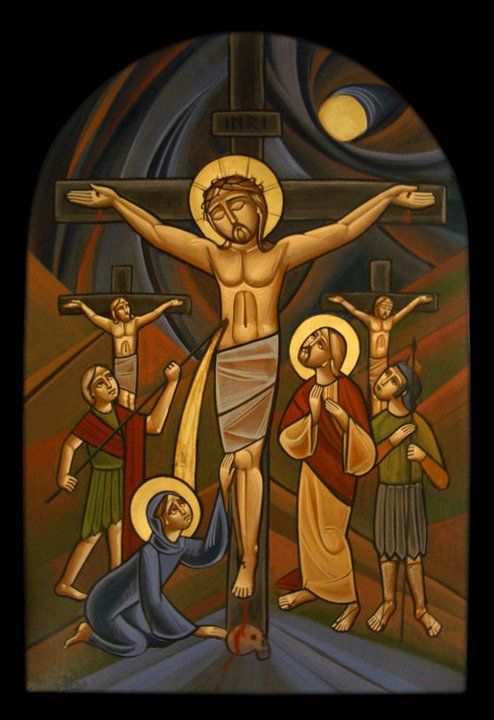
Generally, in the liturgical season of Advent, Christians try to remember the “good part” of salvation history. We’re preparing for our hearts for little baby Jesus to arrive at Christmas. Perhaps we will light the candles on the Advent wreath or set up a manger scene. We read St. Luke’s account of the Annunciation to Mary that she would conceive of the Holy Spirit. We know we’re supposed to only be singing Advent carols, but you know, some Christmas carols sneak in there. O Come, O Come Emmanuel is replaced with Silent Night. Nativity plays take place, holiday candy abounds. Sadly, however, in the excitement of it all, we neglect Christ’s purpose of coming. It’s not just that “He’s the Reason for the Season!” but something more sobering. Our Blessed Lord was born to die.

Archbishop Fulton Sheen, in defense of this point, said simply:
…to Christ, death was the goal and fulfillment of his life, the gold that He was seeking. Few of His words or actions are intelligible without reference to His Cross. He presented Himself as a Savior rather than merely as a Teacher. It meant nothing to teach men to be good unless He gave them the power to be good, after rescuing from the frustration of guilt. (Life of Christ, 14)
Think of this. Nothing in Our Lord’s life, not even the majestic Gloria in Excelsis Deo of the heavenly host to shepherds watching their flocks means anything without Jesus’ death. Yet such a notion upsets us, doesn’t it? Today there’s no greater Scrooge or buzzkill to the secular Christmas season than that of the cross of Our Lord. Furthermore, nothing is as startling to the modern eye as a crucifix. It’s audacious. An actual body is hanging on it. And if there’s one thing we can’t have in modern society, it’s a reminder that all of us will die. A memento mori, as it were, is taboo. It seems to be bad taste. Why would one, in good conscience, try and remember a public execution? We worship a God not of the dead, but of the living, after all (Mark 12:27). Let’s put Jesus back into the manger. As Christians we shirk from the story of the Passion and want to forget the “bad part” because, let’s face it: crucifixion is ugly. We’re afraid of death. Especially when that crucified God is staring us in the face.

According to St. Athanasius of Alexandria, however, a God with a face is precisely the point of the Catholic religion. Recently I spent a night reading his On the Incarnation as a devotional guide to Advent. While that five-times-exiled veteran of orthodoxy had much to say on the wonder that is the Second Person of the Trinity’s assuming human flesh into the Godhead, there was something that struck me. His language was predominantly crucified. Almost eerily obsessed with the way in which Jesus died. In an instructing but loving way, Athanasius says:
…if any honest Christian wants to know why He suffered death on a cross and not in some other way, we answer thus: in no other way was it expedient for us, indeed the Lord offered for our sakes the one death that was supremely good. (On the Incarnation, 54).
God the Son’s death on the cross was supremely good? That’s jarring. How can we say that being stripped naked, whipped to bloody pulp, and being deserted by nearly all your followers is good? Yet Athanasius continues:
He had come to bear the curse that lay on us; and how could He “become a curse” otherwise than by accepting the accursed death? And that death is the cross, for it is written, “Cursed is every one that hangeth on a tree.” Again, the death of the Lord is the ransom of all, and by it “the middle wall of partition” is broken down and the call of the Gentiles comes about. (On the Incarnation, 54-55)
According to St. Athanasius, who was only merely echoing St. Paul in Galatians (who in turn was quoting Deuteronomy), Christ became a curse. That is, as the God-man, Jesus extinguished the sin-tainted nature of the Old Adam and put it to death in Himself, the New Adam. This does not mean the Lord was Himself sinful, the letter of Hebrews clearly teaches He never sinned (Hebrews 4:15).  Rather, it means this: in uniting Himself to humanity in a body, Christ can be both a priest and victim when he undergoes the passion. The cross may be a scandal, but it is the most necessary of scandals. Because Jesus is Emmanuel, God with us, he can know humanity for it really is, and call us back to the heights for which He created us for. Heights which he cleared the way for in the lifting up of His cross. Heights that will lead back to the Father who sent Him. As Athanasius puts it:
How could He have called us if He had not been crucified? Here again, we see the fitness of His death and of those outstretched arms: it was that He might draw His ancient people with the one and the Gentiles with the other, and join both together in Himself. Even so, He foretold the manner of His redeeming death, “I, if I be lifted up, will draw all men unto myself.” (On the Incarnation, 55)
Going along though these mediations Athanasius becomes a little punch drunk. Like St. Paul, he starts boasting. Which is acceptable if it is in the cross (Galatians 6:14). He reveals that, though Christians love the cross of Our Lord, we don’t really love death in and of itself. Instead, he notes:
All the disciples of Christ despise death; they take the offensive against it and, instead of fearing it, by the sign of the cross and by faith in Christ trample on it as something dead. Before the divine sojourn of the Saviour, even the holiest men were afraid of death… .But now that the Savior has raised His body, death is no longer terrible, but all those who believe in Christ tread it underfoot as nothing, and prefer to die rather than deny their faith in Christ, knowing full well that when they die they do not perish, but live indeed, and become incorruptible through the resurrection….Death has become like a tyrant who has been conquered by the legitimate monarch; bound hand and foot as he now is, the passers-by jeer at him, hitting him and abusing him, no longer afraid of his cruelty and rage, because of the king that has conquered him. So has death been conquered and branded for what it is by the Saviour on the cross. (On the Incarnation, 57-58)

As Christians living the Paschal Mystery of Our Lord, death no longer binds the race of Adam like it had. In the Life, Death, and Resurrection of Jesus, there is a new race of men. These men will be crucified, dead, and resurrected. They will rise again to die now no more. And in so doing, both Paul and Athanasius tell us that we will exult in that cry of I Corinthians 15:55: “O Death, where is thy victory? O Grave, where is thy sting?” Our joy rests in that “death is daily proved to be stripped of all its strength” (On the Incarnation, 62). For the Word, having been made flesh, crucified and risen for sinful man, cannot be defeated.


Why is the Incarnate Word undefeatable? The answer is twofold. The first way to approach the question is to realize that Our Lord humbled Himself. The humiliation of the Passion to many eyes seemed a resounding defeat. God the Father knew that His Son was the one sacrifice that would forever fragrance Heaven in the way bullocks never could. Namely, Jesus was the “broken spirit” and the “heart that is humbled and contrite” which the Father could never “disdain” (Psalm 51:19). The second way is this. The humility and great Love of God surpasses the power of death, which can only be proud. Sin entered the world through the pride of man in the Garden and his disobedience. Disobedience was truly made sin because Adam and Eve’s hid from the Lord after the fact. And even then, the Lord walked about the Garden seeking for man created in the imago Dei. As Genesis 3:15—commonly called the Protoevangelium (first Gospel)—shows us, God had a plan to use the woman’s seed to crush the head of that evil serpent. Sin, pain, and death may have entered the world with Original Sin, but God is to be praised. Because with that felix culpa He had a remedy—He would do something to save us. With God’s intervention, Adam would walk once more in Paradise with his Maker.

In the cross and in nothing else, there is freedom. G.K. Chesterton once quipped that “The cross opens its arms to the four winds; it is a signpost for weary travelers” (Orthodoxy, 48). Christ is the leader of our race’s victory over death, why ought we who are purchased with His Precious Blood be ashamed of it? We may get discouraged in our journey during this life, but it is no real reason to despair. Our Lord has put death to death. Christ conquers, reigns, and commands. This Advent season, let us keep in mind the words of Sacred Scripture and those mediations of St. Athanasius. With every glance at the manger, let us also see the wood of the cross, and especially the corpus on the crucifix. Let us put our trust in Him. Let us look upon Him who they have pierced (Zechariah 12:10). For He is lifted in that moment of supposed defeat. Death has been condemned. Eternal life is found in that font which flows from Calvary. And in that lifting of His, even now in our time, hearts are converted; all men are drawn unto that babe born in Bethlehem, born to die. Reveling in the crucified and risen God of our salvation, we can recite those wonderful words of the poet Donne: “One short sleep past, we wake eternally / And death shall be no more; Death, thou shalt die.”

Amen. So be it. Death, thou shalt die.


__________________________________________________________

Works Cited

Athanasius, and C. S. Lewis. On the Incarnation: the Treatise De Incarnatione Verbi Dei. St. Vladimir's Seminary Press, 2002.

Chesterton, G. K. Orthodoxy. Moody Publishers, 2009.

Donne, John. “Holy Sonnets: Death, Be Not Proud by John Donne.” Poetry Foundation, Poetry Foundation, www.poetryfoundation.org/poems/44107/holy-sonnets-death-be-not-proud.

Sheen, Fulton J. The Life of Christ. McGraw-Hill, 1958.